How Many Creases Are There in Cricket
Have you ever watched a cricket match and wondered why there are so many white lines on the pitch? These lines are called creases, and they are the most important part of the game. If a batter steps an inch too far, they might get stumped. If a bowler oversteps by a tiny bit, it is a no-ball! I have watched countless matches where a single centimeter at the crease changed the entire result of the game. Understanding how many creases are there in cricket helps you enjoy the sport much more. Whether you are playing in your backyard or watching a big World Cup match, these lines keep the game fair and exciting for everyone involved.
The Short Answer: How Many Creases Are There in Cricket?
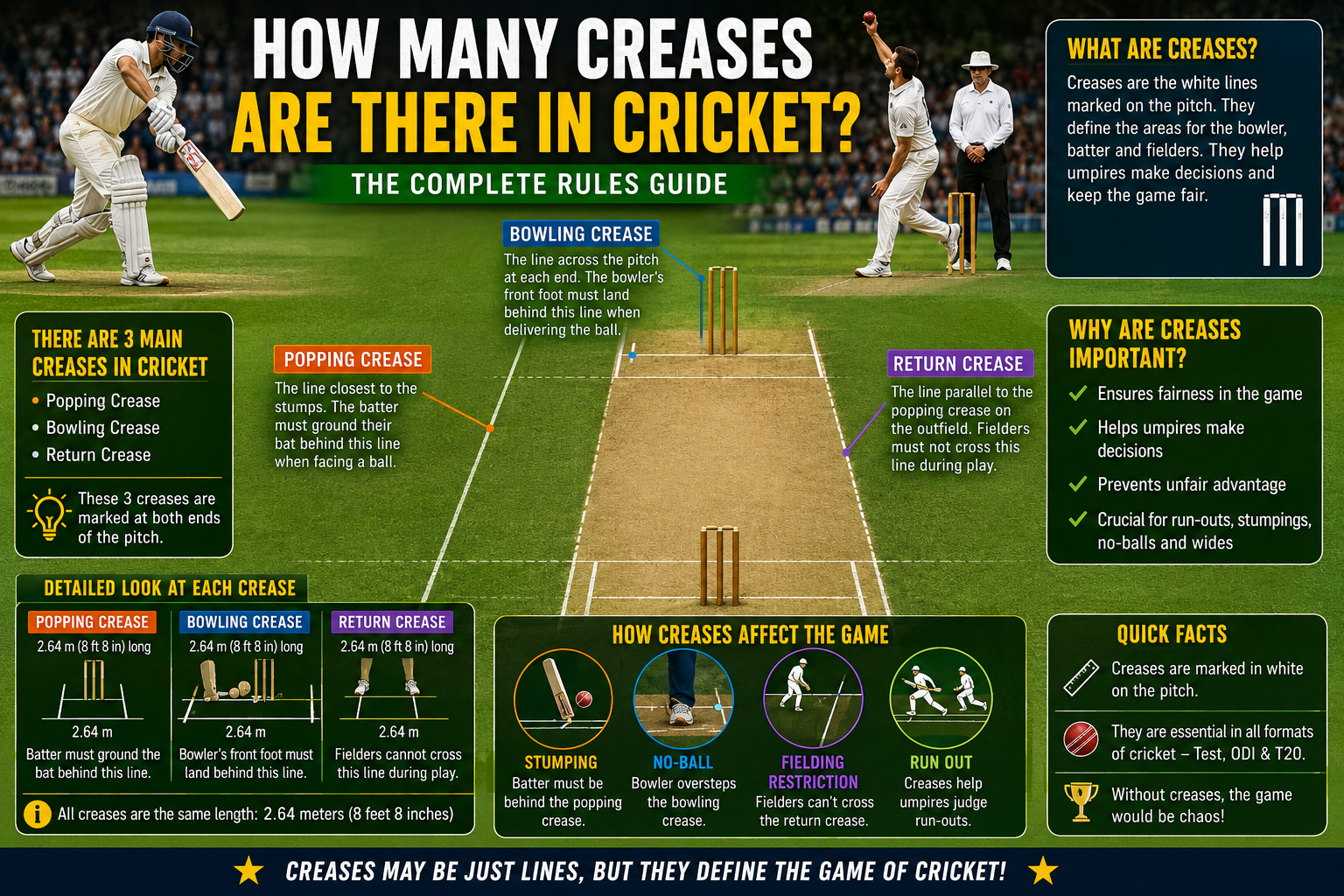
If you want the quick answer, there are technically four main types of creases marked at each end of the pitch. Since there are two ends (the striker’s end and the bowler’s end), you will see these lines repeated. The four types are the popping crease, the bowling crease, and two return creases. This means at each end, you have four lines working together to create the “safe zone” for the players.
In a professional match, these lines must be painted very clearly in white. They help the umpires make big decisions, like run-outs or stumpings. When people ask how many creases are there in cricket, they are usually looking for the names and jobs of these four specific lines. Let’s dive deeper into what each one does.
Understanding the Popping Crease
The popping crease is the line that batters care about the most. It is located 4 feet in front of the stumps. This is the “safe line.” As long as the batter has their bat or a part of their body behind this line, they cannot be stumped or run out. In my experience coaching younger players, I always tell them to “stay inside the paint” because that line is your best friend.
For the bowler, this line is just as important. When they bowl the ball, their front foot must not land completely over this line. If the foot is entirely past the popping crease, the umpire calls a “no-ball.” This gives the batting team an extra run and often a free hit. So, when asking how many creases are there in cricket, remember that the popping crease is the one that gets the most action!
The Role of the Bowling Crease
The bowling crease is a line that runs right through the center of the three stumps. It is 8 feet and 8 inches long. Even though we call it the “bowling crease,” it is mostly used by the umpires to measure where the stumps should be placed. It sits exactly parallel to the popping crease.
In modern cricket, the bowling crease isn’t used as much for active play as the popping crease is. However, it is the home of the wickets. It helps define the length of the pitch, which is exactly 22 yards between the two bowling creases. This measurement is the heart of cricket history and has stayed the same for a very long time.
What Are Return Creases?
On each side of the stumps, there are two lines that run perpendicular to the popping crease. These are called the return creases. They start at the popping crease and go back past the stumps. You can think of them as the side walls of the bowler’s “lane.”
The return creases prevent the bowler from running too wide when they deliver the ball. If a bowler’s foot touches or crosses the return crease line, it is called a no-ball. This ensures that the ball comes from a fair angle toward the batter. When counting how many creases are there in cricket, never forget these two side lines, as they keep the bowler in check.
Detailed Table of Cricket Crease Dimensions
| Crease Name | Location | Length/Distance | Main Purpose |
| Popping Crease | 4 feet in front of stumps | At least 6 feet long | Determines safe zone for batters and no-balls for bowlers. |
| Bowling Crease | Centered on the stumps | 8 feet 8 inches long | Marks the spot where the wickets are placed. |
| Return Crease | Either side of stumps | Unlimited (min 4ft) | Limits how wide a bowler can deliver the ball. |
| Total Lines | Both ends of the pitch | 8 lines total | Provides the legal framework for all dismissals. |
Why the Popping Crease Defines the Game
The popping crease is where the real drama happens. Think about a close run-out. The third umpire spends minutes looking at replays to see if the bat crossed that specific line before the bails were hit. It is the boundary between being “in” and being “out.”
Because the popping crease is so vital, it is often repainted during the lunch or tea breaks in a Test match. Dirt and grass can cover it up as players run back and forth. If you want to know how many creases are there in cricket that truly change the scoreboard, the popping crease is number one. It is the ultimate test of a player’s speed and awareness.
How Creases Help the Umpires
Umpires have a very hard job, but the creases make it possible. The square-leg umpire stands in line with the popping crease to watch for stumpings. The main umpire at the bowler’s end looks down at the popping crease and return creases to watch for foot faults.
Without these white lines, cricket would be a mess! There would be no way to tell if a batter was safe or if a delivery was legal. When we look at how many creases are there in cricket, we are really looking at the tools that help umpires maintain the spirit and rules of the game. They provide the “yes” or “no” for every big appeal.
The 22-Yard Rule and the Crease
The entire game of cricket is built around the 22-yard distance. This distance is measured from one bowling crease to the other bowling crease. If these lines were moved even a little bit, the game would change. Fast bowlers would become too dangerous, or spinners would lose their edge.
I find it fascinating that such a simple set of lines can create such a complex game. When someone asks how many creases are there in cricket, you can explain that these lines are what keep the 22-yard pitch consistent all over the world, from Australia to England. It’s the universal language of the sport.
Common Mistakes Players Make at the Crease
Even professional players make mistakes with the creases. The most common one is the “front foot no-ball.” This happens when a bowler is trying to bowl too fast and forgets to keep their foot behind the popping crease. Another mistake is “batting out of the crease.” Some batters stand far in front of the line to mess with the bowler’s length, but this makes them very easy to stump!
Learning how many creases are there in cricket is the first step for any new player. If you don’t know where your limits are, you will give away free runs or lose your wicket. Always keep a “toe behind the line” to stay safe and keep the game in your favor.
How Creases Have Changed Over Time
In the very early days of cricket, the creases weren’t painted lines. Instead, players actually cut “cuts” or small trenches into the grass! This is why they are called “creases” (like a fold in a shirt). Eventually, people realized that digging holes in the pitch was a bad idea, so they started using white paint or chalk instead.
Today, the rules for how many creases are there in cricket are strictly managed by the Marylebone Cricket Club (MCC). They ensure that every pitch in the world uses the exact same measurements. This history shows how the game has evolved from a simple pastime to a highly precise professional sport.
Frequently Asked Questions
Q1: Can a batter have two creases at once?
No, a batter is safe as long as they are behind the popping crease at the end they are running toward. Each end has its own set of creases.
Q2: What happens if the line is not visible?
The umpire must pause the game and have the ground staff repaint the lines. Visibility is key for fair play.
Q3: Is the line itself part of the crease?
Yes, but remember: “The line belongs to the umpire.” This means you must have something behind the line to be safe. If your foot is exactly on the line but not behind it, you could be out!
Q4: Do junior matches use the same number of creases?
Yes, while the pitch might be shorter for kids, the rule for how many creases are there in cricket (four per end) usually stays the same to teach them the right way to play.
Q5: What is the “danger area” near the crease?
This is an imaginary area in the middle of the pitch. Bowlers are not allowed to run on it because their spikes would ruin the ground for the batters.
Q6: Why is it called a “popping” crease?
The name comes from the old word “pop,” which referred to the hole that used to be dug in the ground before we used painted lines.
Conclusion
Now you know exactly how many creases are there in cricket and why they matter so much. From the safety of the popping crease to the limits of the return crease, these white lines are the invisible referees of every match. They ensure that bowlers stay fair and batters stay safe.
Next time you head out to the pitch or turn on the TV, take a close look at those lines. You’ll see just how much skill it takes to play right on the edge of the crease without making a mistake. Do you think the no-ball rule is too strict, or does it keep the game fair? Let me know your thoughts, and keep enjoying the greatest game on earth!
About the Author