You have done the bucket test. You have tried the dye. You have checked the skimmer and the returns. The pool is still losing water, and you cannot find the source. At this point, the problem is either underground, behind the wall, or in a location that requires specialized equipment to reach.
Professional leak detection uses tools and techniques that are not available to most homeowners. Understanding what these tools do and how they work helps you decide whether to keep searching on your own or bring in someone who can find the leak faster and with less guesswork.
Electronic Acoustic Detection
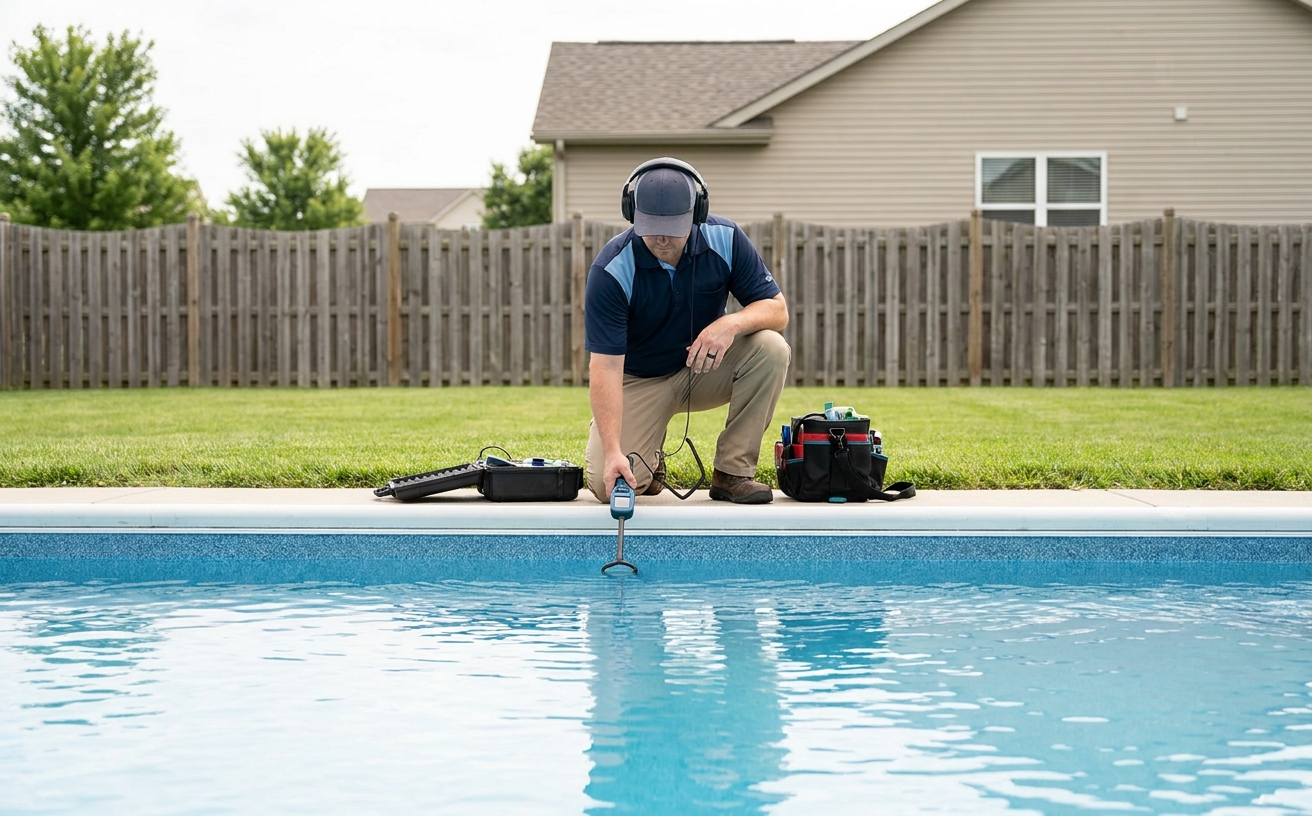
Water escaping under pressure makes noise. It may be too quiet for human ears, especially when the leak is underground or behind a pool wall, but sensitive microphones can detect it. Professional leak detectors use hydrophones, which are waterproof microphones placed in the pool water, to listen for the sound of water escaping from pressurized pipes.
The technician places the hydrophone at various points around the pool and listens through headphones. The sound of a leak increases in volume as the microphone gets closer to the source. By systematically moving the hydrophone around the pool perimeter and along the floor, the technician can triangulate the leak location to within a few inches.
This method works best on pressurized plumbing leaks where water is actively escaping. It is less effective on structural leaks where water seeps slowly through a crack without significant pressure differential.
Pressure Testing Individual Lines
Acoustic detection narrows the search area, but pressure testing confirms it. The technician plugs one end of a pipe run and pressurizes the other with air or water. A pressure gauge monitors the line. If the pressure holds, that section is intact. If it drops, the leak is in that section.
By testing each pipe run individually, the technician isolates the leak to a specific line. This is more precise than the whole-pool tests that homeowners can perform, and it eliminates the possibility of misidentifying which pipe is leaking.
Pressure testing requires specialized plugs, gauges, and the knowledge to interpret the results correctly. Over-pressurizing a line can cause additional damage, which is why this is not recommended as a DIY procedure.
Helium and Tracer Gas Detection
For leaks that are too small or too deep for acoustic detection, some professionals use tracer gas. A mixture of helium or hydrogen and nitrogen is injected into the suspected pipe. The gas escapes through the leak and rises through the ground or concrete, where a sensitive gas detector above the surface locates the concentration point.
This method is extremely precise and can locate leaks under concrete decks, under landscaping, and even under the pool shell itself. It is more expensive than acoustic detection but it finds leaks that other methods miss.
Tracer gas detection is the technology that makes a professional leak detector pool owners turn to when every other approach has failed. It works on the principle that gas molecules are smaller than water molecules and can escape through openings that water barely passes through.
Thermal Imaging
Water leaks change the temperature of the surrounding material. A pipe leak underground creates a cool spot where the water saturates the soil. A structural leak behind the wall creates a temperature differential on the wall surface. Thermal cameras detect these differences and display them as visual heat maps.
Thermal imaging is most effective when there is a significant temperature difference between the pool water and the surrounding ground or air. In hot climates, the contrast between cool pool water and warm soil makes leaks easier to spot. In moderate climates, the temperature difference may be too small for reliable detection.
Thermal cameras are also useful for identifying moisture behind pool walls before it becomes visible as staining or efflorescence. Early detection allows repair before the structural damage from water infiltration becomes extensive.
Dye Testing by Diver
For structural leaks below the waterline, professional dye testing involves a diver who applies dye directly to suspected leak points while underwater. The diver can access areas that are difficult to reach from the deck, including the main drain, light niches, and deep wall fittings.
The diver applies dye from a syringe near each potential leak point and watches which way the dye is drawn. This is the same principle as surface dye testing, but the diver can test many more points in a single session and can apply the dye with much greater precision.
Dye testing by diver is often the final step after acoustic detection and pressure testing have narrowed the search area. The diver targets specific locations identified by the electronic methods and confirms or eliminates them visually.
When to Call a Professional
Not every leak requires professional detection. Surface-accessible leaks at the skimmer, return fittings, or visible cracks can be found and repaired by homeowners. Professional services add the most value when the leak is underground, behind the wall, or otherwise inaccessible.
If you have spent a weekend on diagnosis without finding the leak, the ongoing water loss is already costing you in refilling and chemicals. A professional detection service that finds the leak in two hours saves you days of continued loss and frustration.
The cost of professional leak detection is typically a fraction of the cost of the excavation and repair that follows. Knowing exactly where to dig or where to apply patch material prevents unnecessary demolition and ensures the repair addresses the actual leak rather than a suspected area.
About the Author